

A Life Expectancy Set-Aside, or LESA, is intended to pay future property taxes and insurance for reverse mortgage borrowers. However, the funds allocated for these charges can run out. Explaining that possibility upfront helps clients prepare, but there is much more to know.
The amount the lender must set aside for a LESA is based on three factors: the age and life expectancy of the youngest borrower, long-term interest rate forecasts, and existing property charges. But a LESA calculation cannot anticipate every outcome. For example, borrowers living past life expectancy, low interest rates, and rising property charges all reduce the lifespan of a LESA. Let’s look at all three.
AGE/LIFE EXPECTANCY
The term “life expectancy” is a misnomer here because the actuarial tables used for life expectancy are outdated. For this reason, I prefer to call these “Property Charge Set-Asides.” Nevertheless, duration issues will likely be a greater problem for those with longevity in their genes.
INTEREST RATES
The available LESA grows on the borrower’s behalf at the same rate being applied to their loan balance. Therefore, lower interest rates mean slower growth which can reduce the duration of a LESA. It may seem counter-intuitive, but higher rates are good as they allow the LESA funds to last longer.
PROPERTY CHARGES
Unexpected increases in property taxes or insurance premiums will naturally cause funds to run out sooner than expected.
Think of the LESA as one pool for covered property charges. There are no separate reserves for taxes, homeowner insurance, and flood insurance. So, a sharp increase in one expense leaves less available for others. In states like Colorado that have seen sharp increases in both taxes and insurance, LESAs will be depleted even faster.
CAN WE MODEL LESA DURATION?
Yes. Our ANALYZER Pro is the only tool that can easily model how long a LESA may last, and we can change the inflation rate to model different outcomes. Consider Richard, a single borrower:
- AGE 70
- EXPECTED INTEREST RATE 7.21%
- PROPERTY CHARGES – Taxes $6,000 and Insurance $1,500
With ANALYZER Pro, that’s all we need to calculate a set-aside of $80,193 shown here:
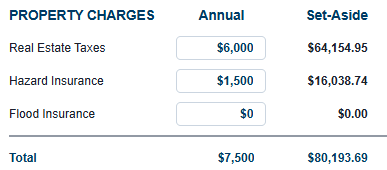
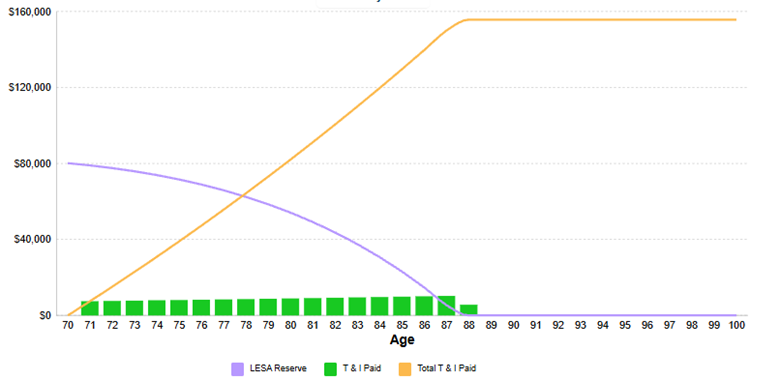
ANALYZER Pro shows that with 2% property charge inflation, Richard’s LESA will pay $155,749 in property charges on his behalf over the next 18 years. This is why the growth factor is so important.
ANALYZER Pro also models the LESA depletion over time as shown below. In Richard’s case, we show the LESA exhausted in 18 years. However, we can also show Richard how higher or lower inflation will impact the duration.
WHAT HAPPENS WHEN LESAS RUN OUT?
Federal regulations require an annual analysis to determine whether LESA funds can cover the next year’s required distributions. If funds are exhausted or insufficient, the lender must notify the borrower.
When a LESA is depleted, borrowers must arrange payment of future property charges. Borrowers can use income, savings, or family assistance. An available line of credit may also help. Otherwise, the lender may use the borrower’s available net principal limit to cover unpaid charges.
If funds and other resources become insufficient, borrowers with substantial remaining home equity may consider refinancing or selling the home and downsizing.