

One of the most valuable features of an adjustable-rate Home Equity Conversion Mortgage (HECM) is its flexibility. Borrowers can draw from the line of credit when funds are needed. Then they can repay some or all of those funds when they are not. Unlike the fixed-rate HECM, the adjustable-rate option allows unused borrowing capacity to remain available for future draws.
But when a borrower makes a voluntary partial prepayment, does the line of credit increase dollar-for-dollar?
The short answer is YES.
When the payment is posted, the available line of credit increases by the amount of the prepayment. Let’s discuss why.
TWO WAYS THE LINE OF CREDIT GROWS
A HECM line of credit increases in two ways. To discuss them separately, I call them “Organic” growth and “Prepayment” growth.
Organic growth: Unused borrowing capacity grows at the same effective rate applied to the loan balance. That rate is the current interest rate plus the annual mortgage insurance premium (MIP) rate.
Prepayment growth: A voluntary partial prepayment reduces the outstanding loan balance, creating additional borrowing capacity.
That second form of growth is frequently misunderstood. With an adjustable-rate HECM, funds may be repaid when they are no longer needed and, subject to the loan terms, become available for future borrowing.
WHERE DOES HUD SAY THAT?
Several HUD sources establish the treatment of partial prepayments including HUD Handbook 4000.1 III.B.1.k.vii. (Application of Prepayments) and the HECM Adjustable-Rate Note. The consistent principle is simple: When the outstanding balance decreases, available borrowing capacity increases, dollar-for-dollar.
WHAT GETS REPAID FIRST?
HECM prepayments are applied to components of the loan balance in a prescribed order, commonly called the servicing waterfall or prepayment waterfall. That order is important for servicing, accounting, and potential tax reporting.
However, the waterfall does not change the dollar-for-dollar effect on the borrower’s available line of credit. The line of credit is not determined by which balance component was reduced. It is determined by the relationship between the borrower’s current principal limit and the outstanding loan balance.
THE BOTTOM LINE
A voluntary partial prepayment on an adjustable-rate HECM increases the borrower’s available line of credit dollar-for-dollar when the payment is posted. And the ANALYZER Pro tool from REVERSE plus can model prepayments accurately and in a way that makes sense to the borrower. As shown here a borrower can see the impact of a one-time payment in year 5:
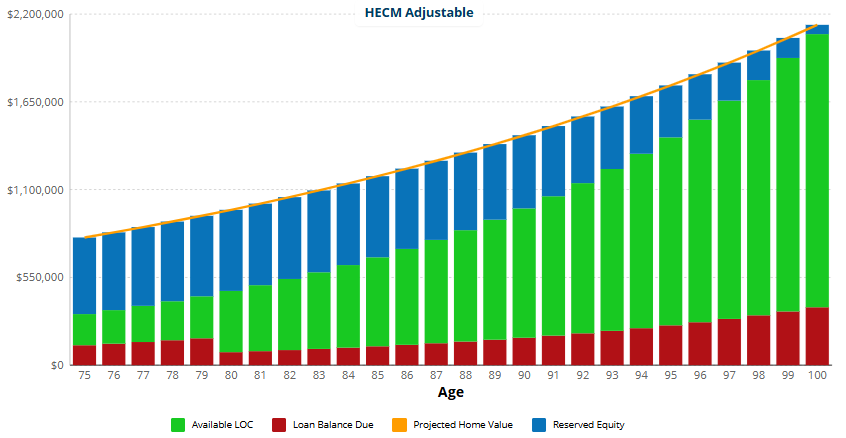
That flexibility—the ability to borrow funds, repay them when they are no longer needed, and preserve future access—is one of the adjustable-rate HECM’s most useful and often overlooked advantages.