
Reverse mortgage professionals work with older homeowners every day. That makes them one of the first lines of defense against elder financial exploitation (EFE). It also puts our work under a microscope. When someone drains a senior’s home equity, families and regulators will ask what went wrong.
The problem is large. FinCEN reports that financial institutions filed over 155,000 EFE-related reports in a single year (June 2022 to June 2023), tied to about $27 billion in suspicious activity. And most cases never reach authorities. An estimate from the National Adult Protective Services Association put reporting of financial elder abuse at just 1 in 44 cases.
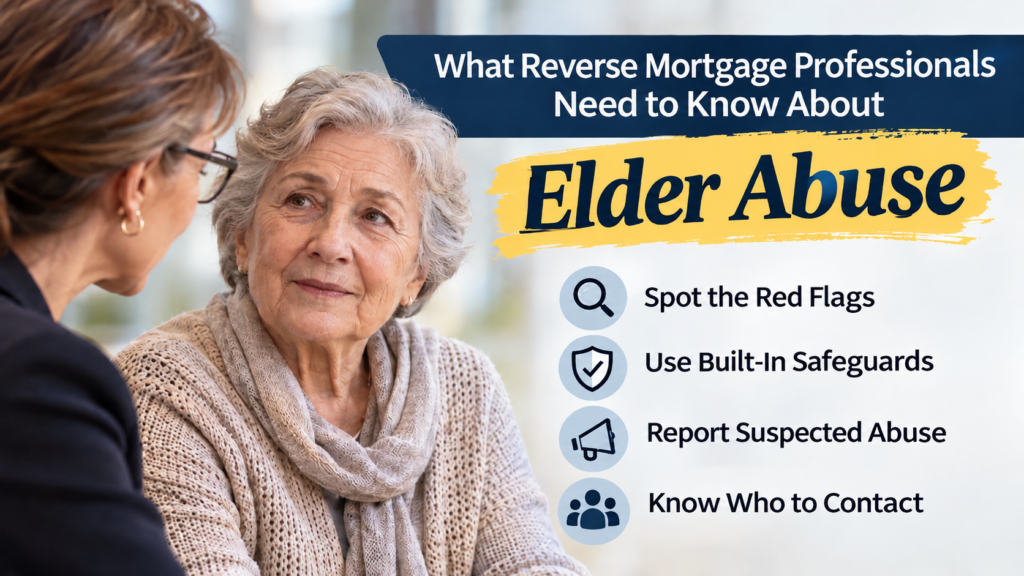
KNOW THE RED FLAGS
FinCEN found that about 80 percent of EFE reports involved scams by strangers. The other 20 percent involved theft, and adult children were the most frequent perpetrators. Both show up in our business. Watch for:
- A relative, friend, or new “advisor” who answers every question for the borrower
- A borrower who cannot explain the purpose of accessing housing wealth
- Pressure to draw more money than is needed to meet their need
- Requests to send proceeds directly to a third party
- Recent changes to a power of attorney, deed, or will
- Urgency, secrecy, or fear when the borrower talks about money
- Confusion or memory loss that raises questions about capacity
When something feels off, speak with the borrower alone. Ask open-ended questions. Document what you hear.
LEAN ON THE SAFEGUARDS ALREADY BUILT IN
The HECM program has protections that work in our favor. Every borrower must complete independent counseling with a HUD-approved counselor before applying. That session gives a neutral third party a chance to spot pressure or confusion.
Federal law also prohibits lenders from requiring borrowers to purchase investments, annuities, or other financial products as a condition of the loan. Never let anyone tie loan proceeds to an investment sale. Finally, encourage borrowers to include a trusted family member or advisor that they chose themselves, not one who chose them.
REPORT WHAT YOU SUSPECT
The CFPB is clear on this point. Its 2019 advisory update urges financial institutions to report suspected EFE to Adult Protective Services (APS), law enforcement, and other authorities, whether or not state law requires it. The Bureau found that only 28 percent of EFE suspicious activity reports showed the institution had also reported directly to APS or law enforcement.
In December 2024, the CFPB joined FinCEN, the Federal Reserve, FDIC, NCUA, OCC, and state regulators in an interagency statement. It recommends employee training, trusted contact designations, and prompt reporting.
The Senior Safe Act of 2018 does not require reporting. However, it does protect covered institutions and trained employees from liability when they report in good faith. Coverage centers on banks, credit unions, broker-dealers, and insurers. So nonbank lenders should confirm with compliance how it applies to them. Know your state’s rules and follow your company’s escalation process, which may include a SAR filing with FinCEN.
WHO TO CONTACT
If someone is in immediate danger, call 911 right away. Otherwise, Adult Protective Services can investigate abuse, neglect, or exploitation. Search “Adult Protective Services” followed by the city, county, or state. These national resources can also help:
- Eldercare Locator (Area Agencies on Aging): 800-677-1116, eldercare.acl.gov
- National Adult Protective Services Association: 202-370-6292, napsa-now.org
- National Elder Fraud Hotline: 833-FRAUD-11 (833-372-8311), ovc.ojp.gov
A reverse mortgage should always strengthen a senior’s retirement, and never fund someone else’s. And protecting older borrowers from elder abuse is part of serving them well. Train your team, slow down when something looks wrong, talk to the borrower alone, and report what you see through the proper channels.