

With the federally insured reverse mortgage known as a Home Equity Conversion Mortgage (HECM) lenders must complete two underwriting tests. If the WILLINGNESS Test looks backward at how a borrower has handled financial obligations, the CAPACITY Test looks forward. It answers the following question: After considering income, debts, and housing expenses, does the borrower appear able to sustain homeownership?
This underwriting process is essentially a residual income calculation. Residual income is the money remaining after expenses are subtracted from effective income. Those expenses may include property taxes, hazard insurance, utilities, maintenance, installment debts, revolving accounts, and recurring obligations. The remaining amount is compared with the following requirements based on the borrower’s region and household size.
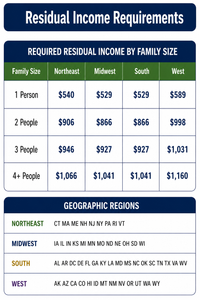
This differs from the debt-to-income ratio used for a traditional mortgage. A HECM does not require monthly principal and interest payments, so the Capacity Test does not measure whether the borrower can handle a mortgage payment. Rather it evaluates whether the borrower can continue paying property charges and meet other financial obligations.
ASSET DISSIPATION
Income is only part of the story. HECM guidelines also permit certain assets to be converted into imputed monthly income through a process known as asset dissipation. Depending on the rules, funds in checking and savings accounts, retirement accounts, investments, annuities, and eligible liquid assets may strengthen the analysis.
That can make a significant difference for retirees. A borrower may report modest monthly income while holding savings or retirement funds. Asset dissipation allows the underwriter to recognize financial strength instead of judging capacity solely by traditional income.
COMPENSATING FACTORS
What happens if residual income falls short? The answer depends on the size of the shortfall and the borrower’s financial profile. Approved compensating factors may help demonstrate capacity. These can include qualifying income sources or financial characteristics that meet FHA’s documentation rules.
TEST RESULTS
If the standard still is not met, a Life Expectancy Set-Aside, commonly called a LESA, may be required to help fund property charges. The lender must still determine that the HECM represents a sustainable solution.
How originators explain the process matters. Saying, “We need to see if you make enough money,” can make borrowers feel judged. A clearer explanation is: “We are required to determine whether this loan will remain a sustainable solution for you over time.”
The Capacity Test is more than another underwriting hurdle. It is a safeguard designed to reduce financial distress. Skilled reverse mortgage professionals use it proactively. They gather documentation early, identify eligible assets, calculate residual income accurately, and structure the loan around the borrower’s long-term ability to remain safely in the home.