
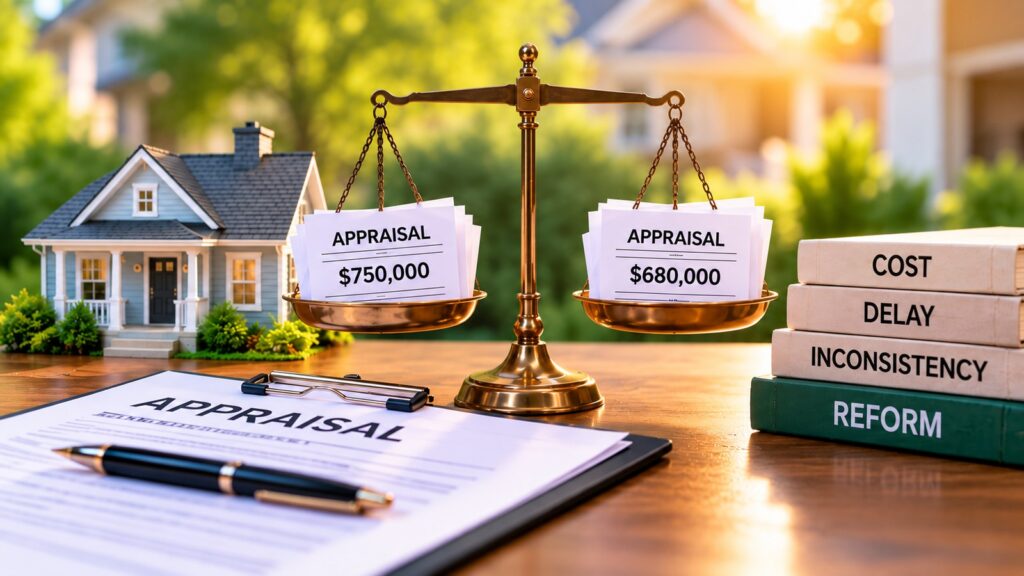
In 2018, the Federal Housing Administration (FHA) introduced the HECM Collateral Risk Assessment, commonly known as the “Second Appraisal Policy.” Under the policy, FHA’s automated valuation review analyzes the initial appraisal submitted for a Home Equity Conversion Mortgage (HECM). If FHA’s risk assessment determines that additional support for the property’s value is necessary, a second appraisal is required before the loan can close. When two appraisals are obtained, the lower value is used to calculate the HECM’s maximum claim amount.
The rationale is understandable. FHA identified inflated property valuations as a concern and sought to strengthen the accuracy of appraised values. Naturally, this second appraisal policy reduced appraisal-related risk to FHA.
But a legitimate objective does not necessarily make the chosen solution good policy. One must also consider the resulting cost to the borrower, cost to the lender, and reputational risk. Here are some of my concerns:
MANDATORY USE OF THE LOWER VALUE
One problem is the lender must use the lower of the two values. A second appraisal does not establish which valuation is “correct.” It simply produces another professional opinion. Appraisal variability is inevitable, particularly in unique, rural, or rapidly changing markets. Yet when two qualified appraisers reach different conclusions, FHA automatically favors the lower number rather than evaluating which appraisal provides the more credible analysis. This can reduce a borrower’s available proceeds even when the higher appraisal is well supported.
COST AND COMPLEXITY
The policy also adds cost and complexity to what is already perceived to be an expensive financial product. The second appraisal can be financed into the HECM, but financing a cost does not make it free. It increases the borrower’s loan balance. The second appraisal can cost $800 or more, while high-value homeowners may already spend more than $1,000 on appraisal-related costs.
PLF TABLES ALREADY ACCOUNT FOR APPRAISAL VARIABILITY
A Principal Limit Factor (PLF) is similar to what we call Loan-to-Value (LTV) percentages for forward loans. Unlike LTVs, PLFs are set for each loan based on the age of the borrower and long-term interest rates. But PLFs were also reduced multiple times in the last 20 years to account for risk to FHA. One of those risks is variability in appraised values. The most recent PLF adjustment occurred in 2017, just prior to the implementation of the second appraisal policy. Therefore, many HECM borrowers today qualify for less money because of a 2018 policy that already addressed the same risk in 2017.
INCREASED LIKLIHOOD OF APPRAISAL BIAS
Perhaps most importantly, requiring another human appraisal can actually increase the opportunity for appraisal bias and inconsistency. Two appraisals mean two opportunities for errors, questionable comparable selection, measurement problems, or differing professional judgments. FHA itself recognizes that appraisal quality requires meaningful review and provides mechanisms for addressing materially deficient appraisals.
HOMES WITH VALUES EXCEEDING THE HECM LIMIT ARE BEING FLAGGED
When the first appraisal indicates a home value of $1.75 million it seems unnecessary to require a second appraisal. The home’s value is already limited to a lower amount based on the HECM limit for that calendar year. In 2026, the applicable value is already reduced $500,000 to approximately $1.25 million.
THERE IS A BETTER APPROACH
FHA should reform the Collateral Risk Assessment so that a second full physical appraisal is not the automatic solution. An appraiser has already visited the property. Instead, FHA should allow the use of automated valuation models, market data, desk reviews, and other technology-based valuation tools to validate the initial appraisal. A second physical appraisal should be reserved for cases where the available evidence indicates a material valuation problem.
Simply permit a desk appraisal or equivalent technology-based model and modify the algorithm so that properties with first appraisal that are 10% above the HECM statutory limit are not unnecessarily flagged.
HUD should protect the FHA insurance fund, but it should do so intelligently. The goal should NOT be “two appraisals are better than one.” If that is the goal, then why not order 5 appraisals?
Modern valuation technology gives FHA the opportunity to achieve the stated objective with greater accuracy, lower cost, less delay, and less burden on older homeowners.
Reforming the Second Appraisal Policy would not weaken the HECM program. Done properly, it would make the program more efficient, more borrower-friendly, and potentially more effective at managing the very valuation risk the policy was created to address.