

If you’ve ever originated a reverse mortgage, you’ve probably had the same reaction as nearly every borrower: “Why are there so many @#$%ing disclosures?”
It’s a fair question. The application package alone can exceed 200 pages. By the time you reach closing, you’ll likely see another stack of documents just as thick. It can feel overwhelming, even intimidating.
I fully support disclosure reform. And if our regulators asked me to help simplify the reverse mortgage disclosure stack, I’d volunteer today. But until that day comes, there’s an important reason these documents exist.
A REVERSE MORTGAGE IS MORE THAN A TWO-PARTY LOAN
Most traditional mortgages involve two parties: the borrower and the lender. A Home Equity Conversion Mortgage (HECM) is different. A HECM is really a three-way relationship involving:
- The Borrower(s), and often an eligible non-borrowing spouse
- The Lender
- HUD (with FHA as the insurer)
Think of it as a triangle rather than a straight line. The borrower makes promises to the lender. The lender makes promises to HUD. And HUD provides important protections to the borrower through the federally insured HECM program.
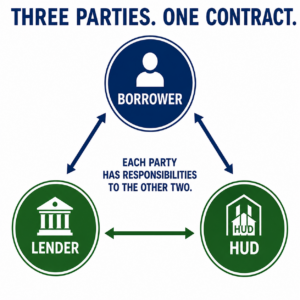
That additional relationship creates additional responsibilities, AND additional disclosures.
THE PAPERWORK EXISTS TO PROTECT ALL PARTIES
Many borrowers assume disclosures ONLY exist to protect the lender. In reality, many exist to protect the homeowner.
The HECM program includes mandatory independent counseling, non-recourse protections, standardized costs, borrower safeguards, financial assessment requirements, occupancy rules, and federally required explanations of how the loan works. Every one of those protections requires documentation.
In essence, many of the consumer protections people appreciate most are the very reasons the paperwork is so extensive.
THREE DISCLOSURES THAT REALLY MATTER
While borrowers don’t need to memorize every page, three disclosures deserve special attention.
- The LOAN COMPARISON helps borrowers compare products, payout options, projected proceeds, loan structures, and interest rates.
- The TOTAL ANNUAL LOAN COST (TALC) disclosure projects the total cost of borrowing over different time periods. It isn’t intended to predict what will happen, but it does show that a reverse mortgage is more expensive as a short-term solution.
- The AMORTIZATION SCHEDULE illustrates how the loan balance, available line of credit, and estimated remaining equity may change over time. When explained properly, it helps borrowers understand how the reverse mortgage behaves over time.
These documents are also reviewed during the required HUD-approved counseling session because they are central to understanding the transaction.
DON’T CALL IT “JUST PAPERWORK”
One of the worst things a loan originator can say is, “Don’t worry. It’s just paperwork.”
It isn’t. Every disclosure exists because someone, somewhere, experienced a problem that regulators wanted future borrowers to avoid. The documents are intended to promote transparency, reduce misunderstandings, and encourage informed decisions.
Rather than rushing through signatures, experienced reverse mortgage professionals will pause and explain the purpose behind the most important documents, and encourage questions along the way.
Yes, there are a lot of disclosures. Probably too many. But until the system is simplified, remember that those hundreds of pages are not evidence that a reverse mortgage is suspicious. They are evidence that the program is one of the most highly regulated consumer financial products available.