
Listen To This Article
Reviewing the cost structure of a HECM reverse mortgage
The Federal Housing Administration (FHA) provides the insurance that allows most of our country’s reverse mortgages to function. The loan product I’m talking about is the Home Equity Conversion Mortgage (HECM). And with FHA’s insurance, lenders can offer this non-recourse loan with very favorable terms. But this insurance comes at a cost.
First, let me address the most common question regarding a HECM’s largest upfront cost, the Initial Mortgage Insurance Premium (IMIP):
IS THE HECM MORTGAGE INSURANCE EXPENSIVE?
It may surprise you that I believe the answer to be a resounding “NO!” The cost is more than fair if you understand the value of the product. You get what you pay for, and I’d personally pay for a HECM today if I were age-eligible.
- A non-recourse loan product,
- That allows the borrower to retain ownership,
- With a loan term that is viable to age 150,
- With an extremely competitive interest rate,
- With a line-of-credit (LOC) that grows in your favor, and
- A loan balance that typically doesn’t require repayment until you sell, or permanently vacate, the home.
While it is an exceptional value, we are asking the wrong question. The better question to ask is this:
IS THE MORTGAGE INSURANCE STRUCTURE APPROPRIATE?
No, it’s not. The HECM mortgage insurance is poorly structured for both the borrower and the FHA. I would add that it also creates significant challenges for the lenders and loan originators trying their best to help older homeowners age-in-place.
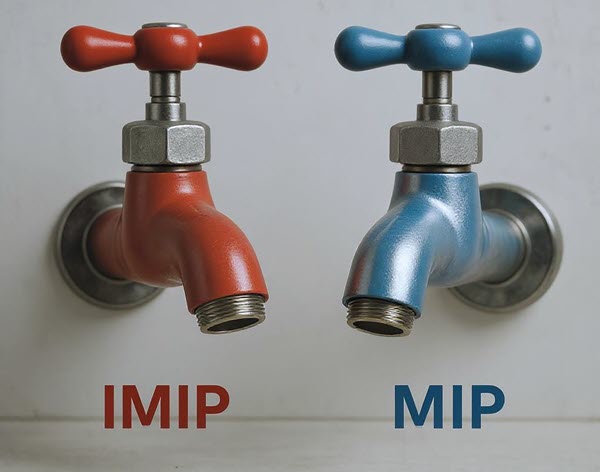
Consider that FHA has two faucets that pump money into FHA’s insurance fund:
- Initial Mortgage Insurance Premium (IMIP) – Currently, the HECM carries an initial premium (IMIP) of 2% of the home’s value up to the limit for loans with case numbers in that calendar year. This is typically financed into the loan.
- Ongoing Mortgage Insurance Premium (MIP) – FHA collects ongoing MIP calculated at an annual rate of 0.5% of the outstanding loan balance but it accrues monthly at 1/12th of that rate.
Continuing with the “faucet” theme, the IMIP faucet (#1) is currently SCALDING HOT and unacceptable to many homeowners. 2% IMIP is a massive upfront cost for low-draw borrowers.
Consider Bill, a homeowner with a paid-off home. Bill needs a new roof that will cost $15,000 but doesn’t want a required monthly payment. The logical solution is a reverse mortgage, but the upfront cost of a HECM is double the cost of his roof.
WHAT IS THE SOLUTION?
If FHA were to make the following three changes to the HECM program, more borrowers would benefit from a HECM and there would be no adverse impact to FHA’s insurance fund:
- DECREASE the front-end IMIP charge from 2% to 1%,
- INCREASE the back-end MIP rate from 0.50% to 0.75%, and
- APPLY this MIP structure to all HECM loans including HECM refinances
The HECM program was able to help many older homeowners in the past when the product offered low upfront costs. The product known as the “HECM Saver” charged 0.01% IMIP and was favored by the financial planning community. The “HECM Standard” charged 0.50% IMIP for homeowners that utilized less than 60% of their available funds upfront.
Lowering the high front-end IMIP and increasing the low back-end MIP will balance the costs of the loan and make the HECM product more “consumption-based.” The more the borrower borrows, the more insurance they pay.
Let’s stop scalding older homeowners with 2% IMIP costs and charge insurance fees that are commensurate with the risk they create.